
June 12, 2025
At Fiberloop, we see the challenge of composite waste not as a dead-end — but as one of the clearest opportunities for circular innovation in the materials economy. From wind turbine blades and airplane fuselages to boats and performance sports gear, composites are embedded in modern industry. Yet, they were never built to be disassembled or recycled.
As industries move toward net-zero goals and sustainability mandates, composite waste remains one of the most persistent gaps in the circular economy. Our team is focused on changing that.
The Problem: Why Composites Are So Hard to Recycle
Composite materials — especially those built on glass or carbon fiber reinforced with thermoset resins — are structurally excellent, but recycling nightmares. They're built to last, not to be reused.
Core challenges we identified:
- Thermoset resins don’t melt, making them incompatible with conventional plastic recycling methods.
- Multilayer configurations resist disassembly or grinding.
- There is no mature recycling stream for these materials — yet.
The EU is phasing out landfilling of composite waste by 2025 under the Circular Economy Action Plan. This presents both a compliance risk and a new market opportunity.
Circular Solutions on the Rise
We’re seeing an accelerating wave of technical and business model innovation around composite waste.
1. Pyrolysis — Our Core Focus
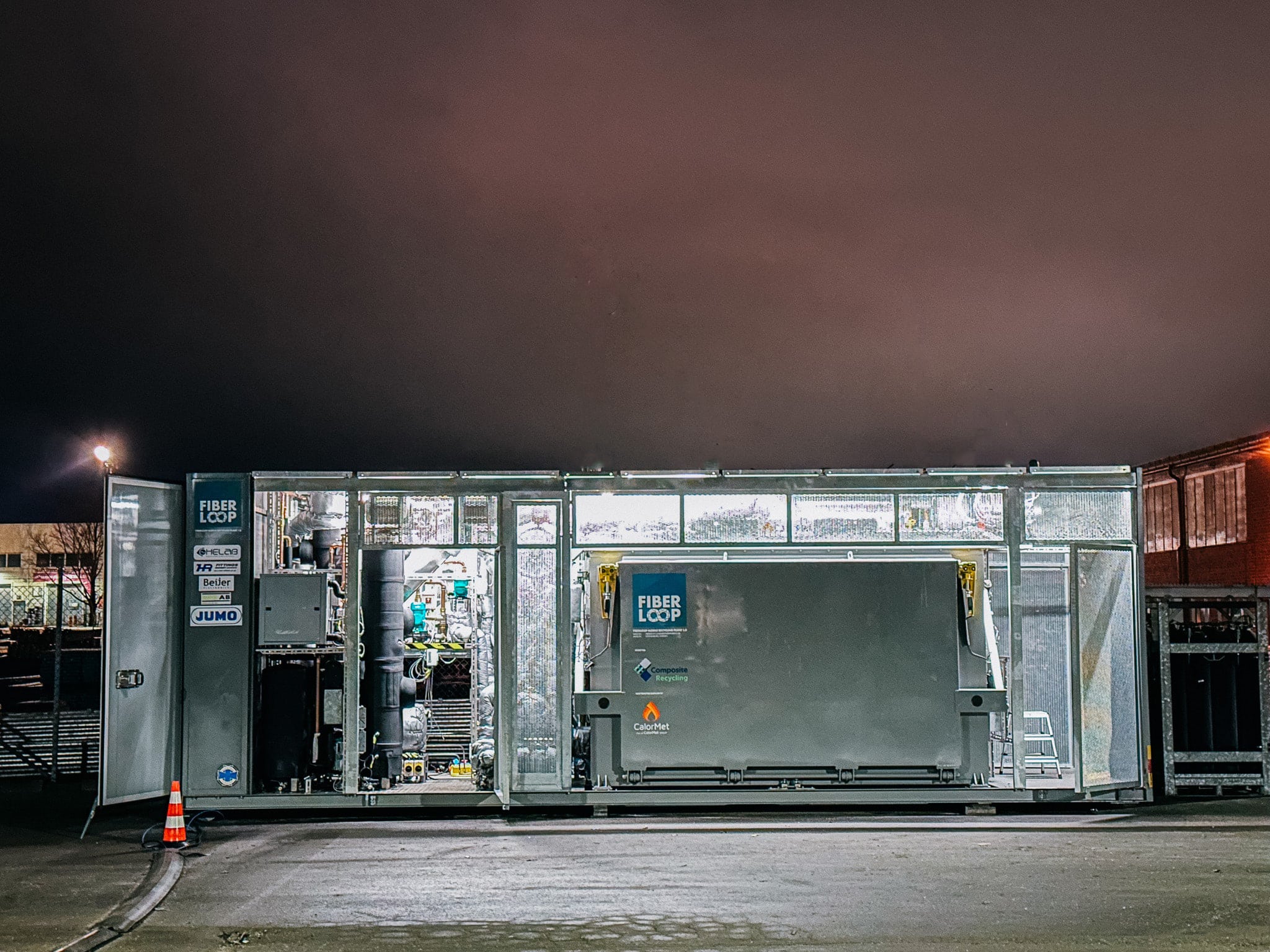
Our modular, batch-based pyrolysis units thermally decompose composite waste in oxygen-free environments, recovering:
- Fibers suitable for reuse or upcycling
- Pyrolytic oil, usable as energy or chemical feedstock
This approach reduces transport needs, decentralizes recycling, and produces clean, usable outputs from “unrecyclable” inputs.
2. Chemical + Mechanical Hybrids
Other labs and startups are exploring resin dissolution through chemical baths post-shredding — promising but not yet scalable.
3. Upcycling Partnerships
We collaborate with companies like Verretex, who specialize in regenerating pyrolyzed fibers into new, high-performance products — such as insulation or composite sheets.
4. Design for Disassembly
Manufacturers are beginning to rethink product design with recyclability in mind. We believe modularity will be key to scaling end-of-life recycling.
Regulation & Market Drivers
The landscape is shifting fast. Regulation is catching up with composite waste:
- EU Green Deal and Circular Economy Action Plan are mandating end-of-life material accountability.
- Extended Producer Responsibility will include composites.
- CO₂ offset credits and ESG reporting requirements are creating a financial incentive to divert composite waste.
Fiberloop’s solution is built to help operators stay ahead of policy and capture emerging value streams.
A Practical Loop: From Waste to Raw Material
Here’s how we imagine a closed-loop scenario:
- End-of-life turbine blades are collected by local waste operators.
- The materials are processed using Fiberloop’s pyrolysis unit.
- Recovered fibers are transferred to upcyclers like Verretex.
- These fibers are used in construction, automotive, or industrial materials.
This circular value chain turns a cost center into a profit opportunity.
What’s Next?
To drive real adoption and scale this market, we believe the following are critical:
- Investment in localized, scalable pyrolysis infrastructure
- Cross-industry collaborations for material traceability and certification
- CAPEX-light models like Recycling-as-a-Service (RaaS)
- Supportive regulation tied to CO₂ accounting and material recovery metrics
Fiberloop is actively piloting these solutions with strategic partners across Europe.
Final Thoughts: Turning a Waste Crisis Into a Resource Revolution
We believe composite waste is not just a liability — it’s an untapped resource. The key is enabling the right technology, incentives, and ecosystems to make the transition.
At Fiberloop, we’re proud to be building that bridge.
Let’s close the loop — together.
Sounds interesting? Let's talk